What Is a Product Information File?
A Product Information File (PIF) is a comprehensive dossier that must exist for every cosmetic product placed on the European Union market. It is the single most important compliance document in the EU cosmetics industry.
Think of the PIF as a product's complete biography: its formulation, how it was made, proof that it's safe, evidence behind its marketing claims, and its animal testing status. Competent authorities in any EU Member State can request to inspect a PIF at any time, without prior notice.
The PIF is mandated by Article 11 of EU Regulation EC 1223/2009 (the EU Cosmetics Regulation), which replaced the earlier Cosmetics Directive 76/768/EEC. Since July 11, 2013, every cosmetic product on the EU market must have a fully compiled PIF available before sale.
Key Takeaway
No PIF = no legal right to sell. It's not a "nice-to-have" document. It is a legal prerequisite for market placement in all 27 EU Member States, plus the EEA countries (Norway, Iceland, Liechtenstein).
Legal Basis: Article 11 of EC 1223/2009
Article 11 of the EU Cosmetics Regulation (EC) No 1223/2009 establishes the legal requirement for the PIF. Here are the critical provisions:
- Article 11(1) — The Responsible Person shall keep a product information file for the cosmetic product at the address indicated on the label.
- Article 11(2) — Defines the six mandatory sections: product description, safety report, manufacturing method, proofs of claims, and animal testing data.
- Article 11(3) — The PIF must be retained for 10 years after the last batch is placed on the market.
- Article 11(4) — The PIF can be maintained in electronic format.
- Article 11(5) — The information must be readily available in the language easily understood by the competent authorities of the Member State.
The regulation also interlinks with Annex I, which specifies the detailed requirements for the Cosmetic Product Safety Report (CPSR) contained within the PIF.
Who Needs a PIF?
The short answer: everyone who places a cosmetic product on the EU market. The legal responsibility falls on the Responsible Person (RP), as defined in Article 4 of EC 1223/2009:
| Scenario | Responsible Person | PIF Obligation |
|---|---|---|
| Manufactured in the EU | The manufacturer (unless another RP is designated by written mandate) | Must compile and maintain PIF before placing on market |
| Imported into the EU | The importer | Must ensure PIF exists and is accessible at the EU address on the label |
| Private label / white label | The company whose name appears on the label | Must have a PIF even if a contract manufacturer produced the goods |
| Distributor modifying an already-placed product | The distributor (becomes the RP for the modified product) | Must compile a new PIF if label, formulation, or presentation changed |
Contract manufacturers, cosmetics laboratories, indie beauty brands, large multinationals, and importers all share the same obligation. The PIF doesn't scale with company size. A one-person brand selling handmade soaps needs the same documentation as a global cosmetics corporation.
The 6 Required Sections of a PIF
Article 11(2) of EC 1223/2009 defines the contents of the PIF. Every Product Information File must include these six elements:
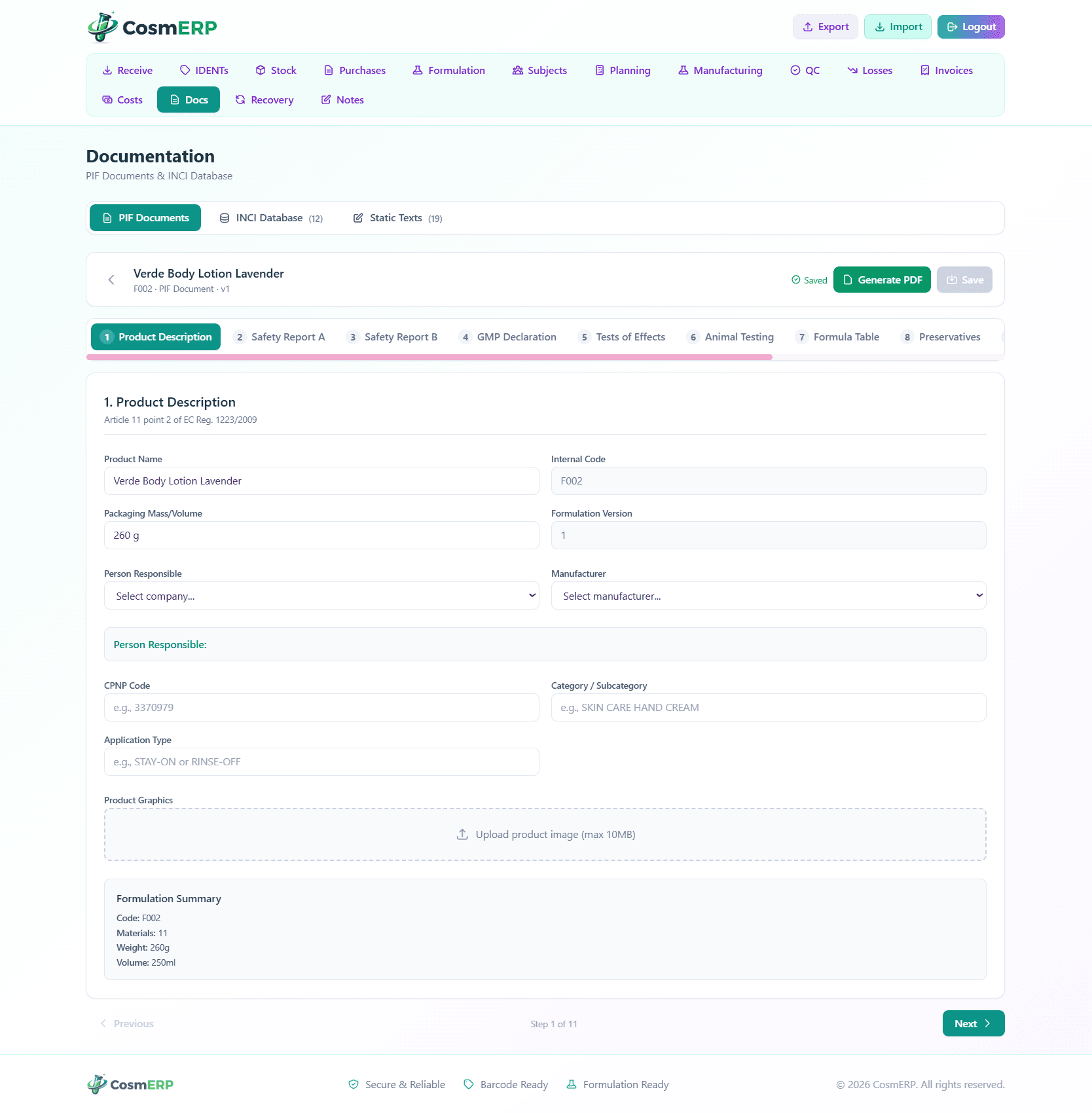
1. Product Description
A clear description that enables the PIF to be unambiguously linked to the actual cosmetic product. This includes:
- Product name and category (cream, shampoo, lipstick, etc.)
- The qualitative and quantitative formulation (full ingredient list with exact percentages)
- The function of the product
- Target market and intended use
- A photo or visual rendering of the product and its labelling
2. Cosmetic Product Safety Report (CPSR)
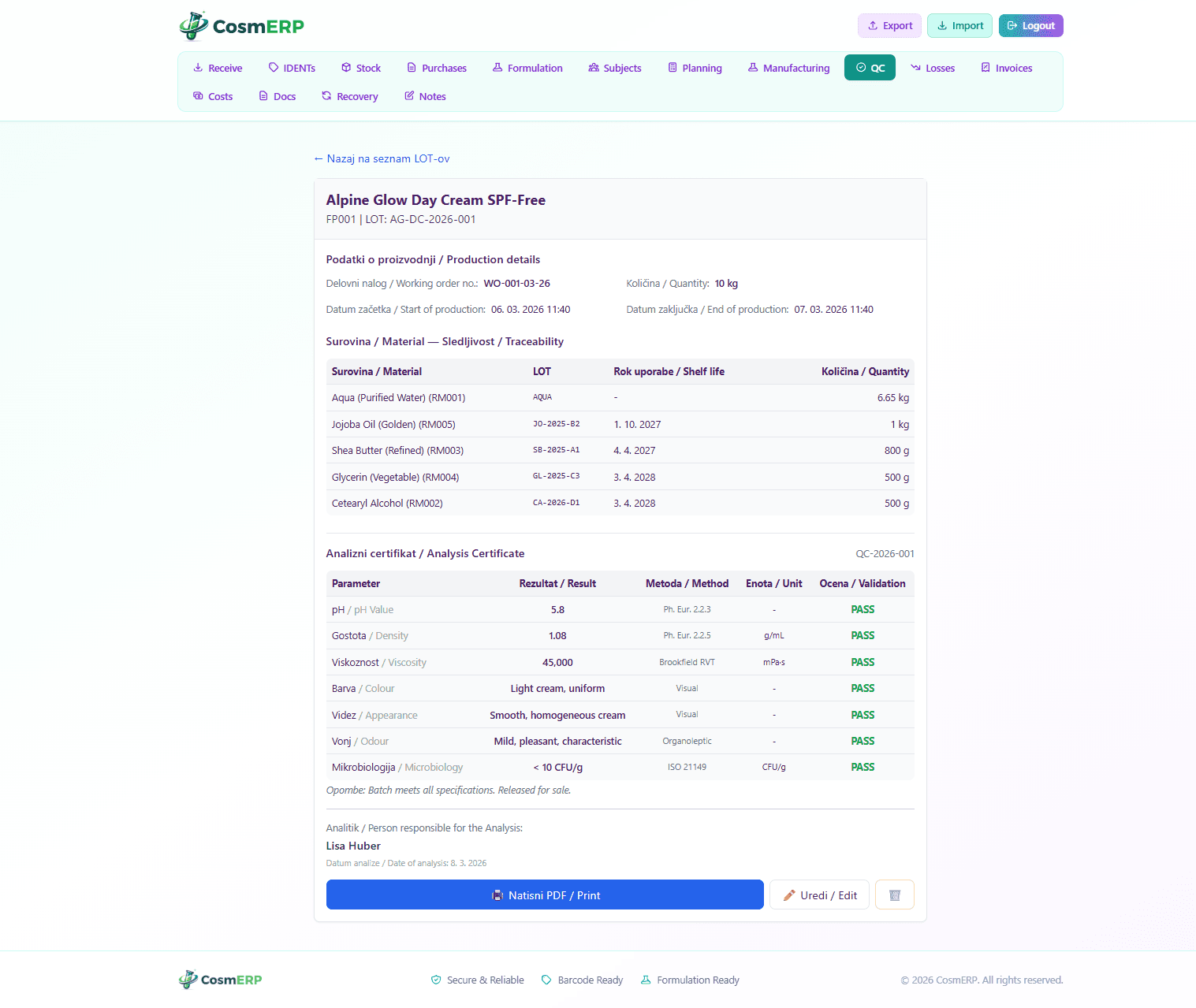
The most critical and complex section. The CPSR must be prepared in accordance with Annex I of EC 1223/2009 and consists of two parts:
- Part A — Safety Information: quantitative/qualitative composition, physical/chemical characteristics, microbiological quality, impurities/traces, packaging, normal/reasonably foreseeable use, exposure data, substance-specific data, undesirable effects, and toxicological profiles
- Part B — Safety Assessment: the conclusion of the safety assessor, a qualified person with proof of qualification (university diploma in pharmacy, toxicology, medicine, or similar). The assessment must be signed and dated.
3. Description of Manufacturing Method
A description of the method of manufacture, with enough detail to ensure compliance with Good Manufacturing Practice (GMP) per ISO 22716. This doesn't have to reveal trade secrets, but it must demonstrate that the product is manufactured according to good practice.
4. Proofs of Claimed Effects
If the product makes efficacy claims (anti-wrinkle, moisturizing, strengthening, etc.), the PIF must contain evidence supporting those claims. This can include:
- In-vivo clinical studies
- In-vitro laboratory tests
- Consumer perception studies
- Published scientific literature
- Expert opinions
Claims must comply with the EU Common Criteria for Cosmetic Claims (Commission Regulation 655/2013): legal, truthful, evidence-supported, honest, fair, and enabling informed decisions.
5. Animal Testing Data
Data on any animal testing performed by the manufacturer, agents, or suppliers relating to the development or safety evaluation of the product or its ingredients. This includes testing performed outside the EU where it was required by third-country legislation.
Note: the EU has a complete ban on animal testing for cosmetics (since 2013 for finished products and ingredients). However, transparency about historical testing is still required.
6. Additional Information (Where Applicable)
For certain product categories, additional information is required. Products intended for children under three years of age, products intended exclusively for external intimate hygiene, and professional-use products must include specific additional data on their safe use.
Generate inspector-ready PIFs in under 2 minutes
CosmERP's 11-step PIF wizard pulls directly from your formulations, INCI database, and stability records. No copy-pasting between spreadsheets. One click, one PDF.
The Cosmetic Product Safety Report (CPSR) in Detail
The CPSR is by far the most complex and expensive part of the PIF. It requires input from a qualified safety assessor and must contain specific technical data defined in Annex I of EC 1223/2009.
Part A: Cosmetic Product Safety Information
Part A is the data collection that feeds into the assessor's conclusion. It must include:
- Quantitative and qualitative composition — The full formula with INCI names, CAS numbers, percentages, and functions of each ingredient
- Physical/chemical characteristics — pH, viscosity, density, stability data
- Microbiological quality — Challenge testing (preservative efficacy testing), microbial limits
- Impurities, traces, and packaging material information — Heavy metals, nitrosamines, 1,4-dioxane, phthalates, and migration from packaging
- Normal and reasonably foreseeable use — How consumers will use the product, including misuse scenarios
- Exposure to the cosmetic product — Application area, amount used per application, frequency of use, total exposure (using SCCS Notes of Guidance calculations)
- Exposure to substances — Individual substance exposure considering all cosmetic sources (aggregate exposure)
- Toxicological profile of substances — For each ingredient: NOAEL, LD50, dermal absorption, sensitisation potential, mutagenicity, carcinogenicity, reproductive toxicity, photomutagenicity
- Undesirable effects and serious undesirable effects — Reports from CPNP, post-market surveillance data, literature
Part B: Cosmetic Product Safety Assessment
Part B is the assessor's professional conclusion and must include:
- Assessment conclusion — a clear statement that the product is safe for human health
- Labelling warnings and conditions of use, if applicable
- Reasoning behind the conclusion, including the Margin of Safety (MoS) calculations for each substance of concern
- The assessor's credentials (name, address, proof of qualification)
- Date and signature
Margin of Safety Formula
For each substance where toxicological data is available, the assessor calculates:
MoS = NOAEL / SED
Where NOAEL is the No Observed Adverse Effect Level and SED is the Systemic Exposure Dose. A MoS of 100 or higher is generally considered safe by the SCCS (Scientific Committee on Consumer Safety).
7 Common PIF Mistakes That Trigger Inspections
Based on published enforcement reports from EU Member States, these are the most frequent PIF deficiencies that lead to regulatory action:
- No PIF at all — More common than you'd think, especially among small indie brands and companies importing products from outside the EU.
- Outdated formulation data — The PIF references version 1 of the formula but the product is on version 4. When you change a formulation, the PIF must be updated.
- Missing or incomplete CPSR — A list of ingredients is not a safety report. Part A data collection AND Part B assessor signature are both required.
- CPSR signed by an unqualified person — The assessor must hold a university diploma in pharmacy, toxicology, medicine, or an equivalent discipline. A chemist with a BSc in chemistry alone may not qualify without additional toxicology credentials.
- No stability data — Stability testing (real-time and accelerated) is part of the physical/chemical characteristics in Part A. "We've been making this for 5 years without issues" is not stability data.
- Missing Margin of Safety calculations — Every nanomaterial ingredient, every preservative, every UV filter, and any substance at a concentration where toxicological concern exists must have a documented MoS calculation.
- PIF not accessible — The PIF must be available at the address on the product label. If an inspector knocks and you can't produce it in a reasonable time, that alone is a violation.
PIF Retention: The 10-Year Rule
Article 11(3) requires that the PIF be retained for 10 years from the date the last batch of the product was placed on the market. This has significant implications:
- If you discontinued a product in 2024, you must keep its PIF until at least 2034.
- "Placed on the market" means when the product first entered the distribution chain, not when the end consumer purchased it.
- For products with a long shelf life, the actual retention can extend well beyond 10 years from the last production batch.
- Document version history is critical. You may need to show which version of a formula was in effect when a specific batch was produced years ago.
This is where physical filing systems start to break down. Paper folders get lost, staff turnover means institutional knowledge disappears, and finding a specific PIF version from 2018 becomes a half-day project. Electronic PIF management solves this permanently.
PIF vs. CPNP Notification: What Is the Difference?
These two requirements are often confused. They are separate obligations under the same regulation:
| Product Information File (PIF) | CPNP Notification | |
|---|---|---|
| Legal basis | Article 11 | Article 13 |
| What it is | A complete dossier (description, CPSR, manufacturing, claims, animal testing) | An electronic notification submitted to the CPNP portal before market placement |
| Where it lives | At the RP's address (physical or electronic) | In the EU's Cosmetic Products Notification Portal (online database) |
| Purpose | Demonstrate product safety and regulatory compliance | Enable market surveillance and poison centre access |
| Contents | Full formulation, safety report, manufacturing method, claim proofs | Product category, name, RP details, country of origin, frame formulation, label photo |
| Retention | 10 years after last batch | Must be updated when product information changes |
You need both. The CPNP notification does not replace the PIF, and having a PIF does not exempt you from CPNP notification. They serve different purposes and are checked by different authorities.
Automating PIF Creation with Software
Manually compiling a PIF for a single product can take days. For companies with dozens or hundreds of products, each needing regular updates, the paperwork becomes a full-time job.
Modern cosmetic ERP and PLM tools can automate significant portions of the PIF creation process. Here's what to look for:
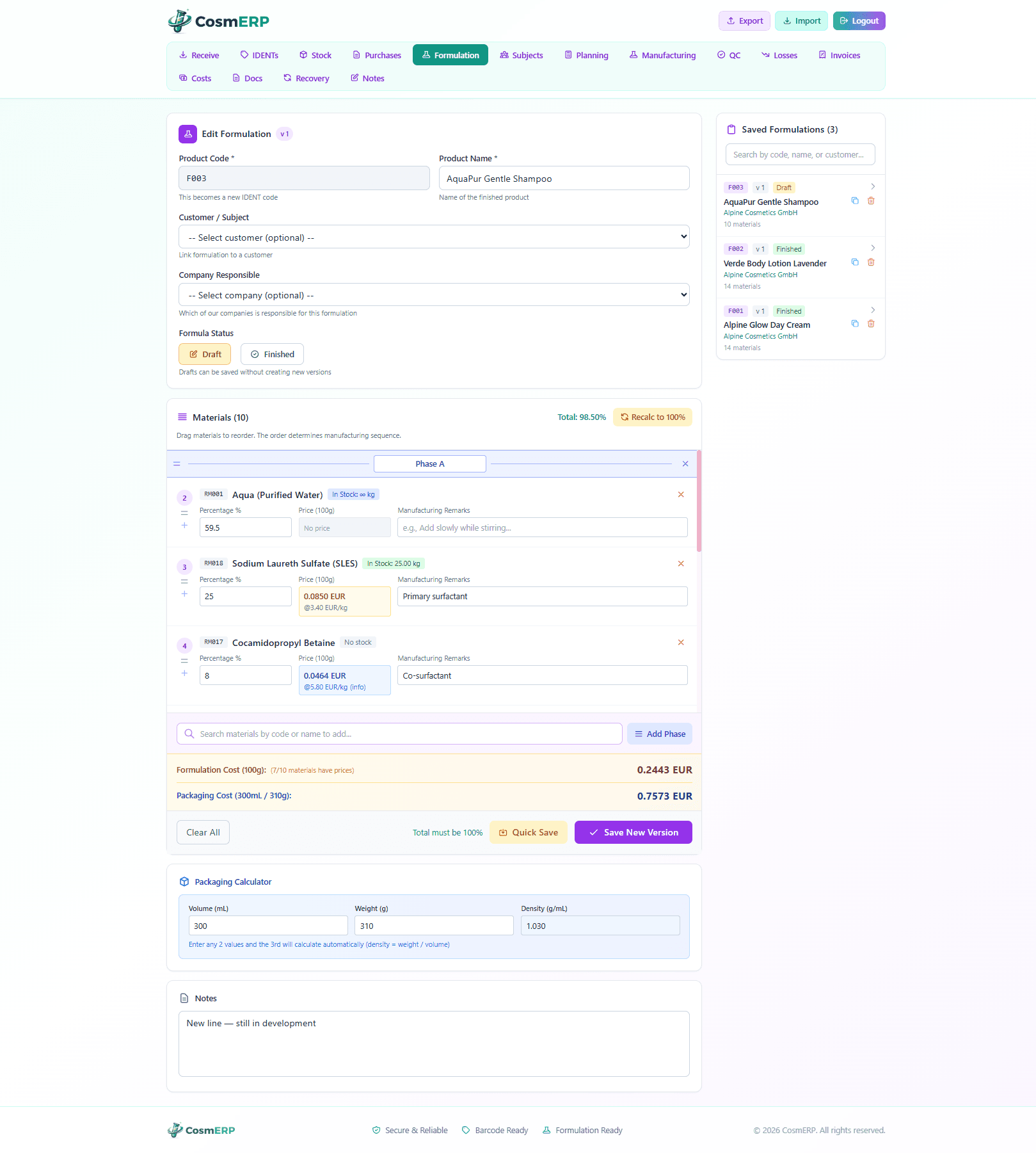
Formulation-linked PIF generation
The PIF should pull directly from your formulation database. When you update a formula, the PIF updates automatically. No manual re-entry.
Built-in INCI toxicological database
CAS numbers, EINECS codes, NOAEL values, LD50, dermal absorption rates, and sensitisation classifications should be searchable and auto-populated.
Automatic MoS calculations
The system should calculate Margin of Safety based on the ingredient concentration in your formula and the exposure scenario, using SCCS methodology.
Version control with audit trail
Every change to a formulation or PIF section should be tracked with timestamps and user identification. This is critical for the 10-year retention requirement.
PDF export for inspectors
Competent authorities expect a readable, structured document. The ability to export a complete, formatted PIF as a PDF on demand saves time during inspections.
Integration with batch records
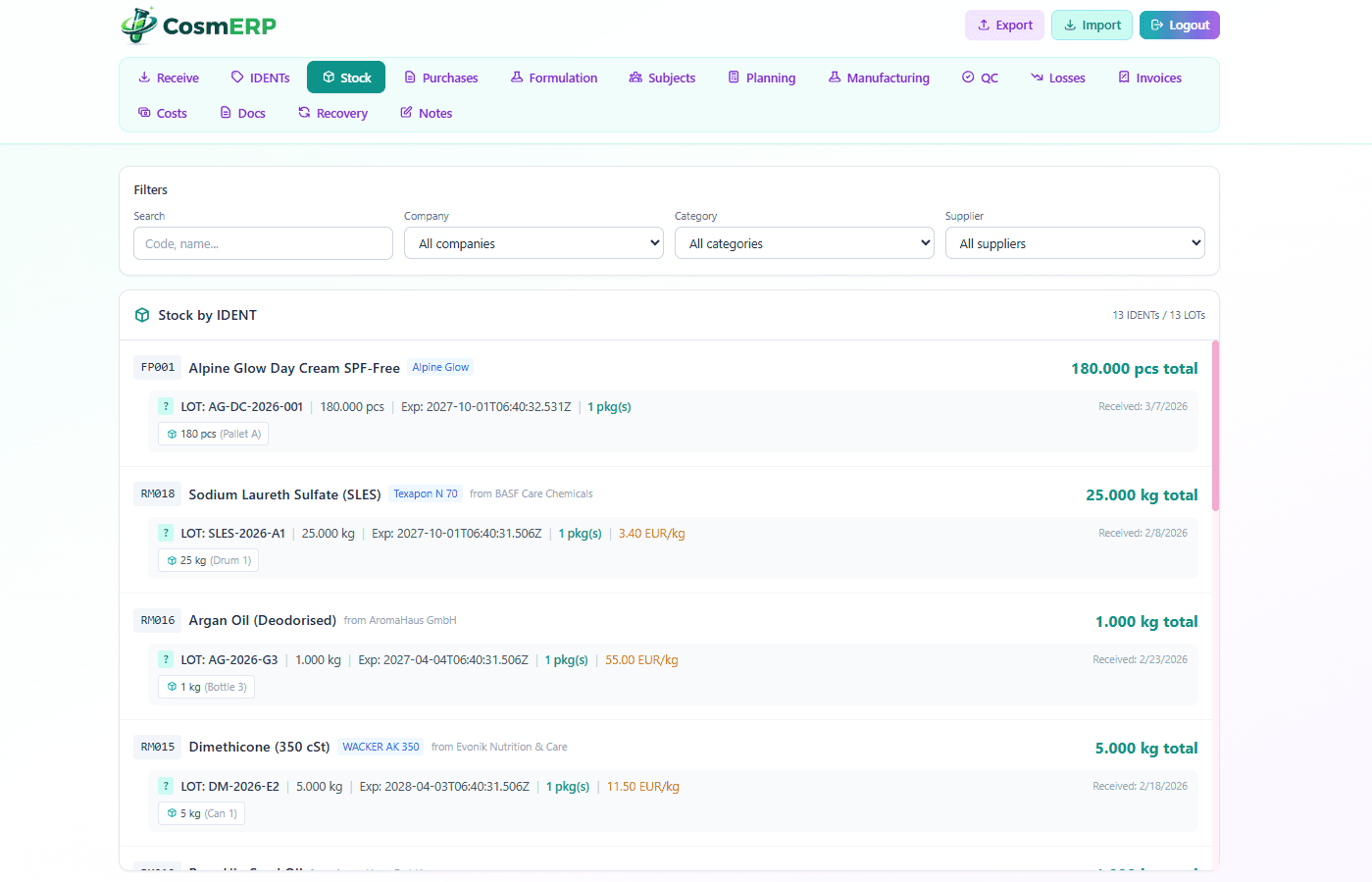
Link each PIF to the specific production batches it covers. When an inspector asks about batch X, you should be able to pull up the exact PIF version in effect when that batch was produced.
Generate inspector-ready PIFs in under 2 minutes
CosmERP's 11-step PIF wizard pulls directly from your formulations, INCI database, and stability records. No copy-pasting between spreadsheets. One click, one PDF.
PIF Readiness Checklist
Use this checklist before placing any cosmetic product on the EU market:
Frequently Asked Questions
What is a Product Information File (PIF)?
A Product Information File (PIF) is a mandatory document required under EU Regulation EC 1223/2009 (Article 11) for every cosmetic product placed on the EU market. It contains the product description, safety report, manufacturing method, proofs of claimed effects, and animal testing data. The Responsible Person must keep it readily accessible for competent authorities for 10 years after the last batch.
Who is responsible for maintaining the PIF?
The Responsible Person (RP) designated under Article 4 of EC 1223/2009 is legally responsible for maintaining the PIF. For EU-manufactured products this is typically the manufacturer. For imported products it is the importer. The RP must ensure the PIF is kept at the address indicated on the product label and is readily accessible in electronic or paper form.
How long must a PIF be kept?
Under Article 11(3) of EC 1223/2009, the PIF must be kept for 10 years following the date on which the last batch of the cosmetic product was placed on the market. This means even discontinued products require ongoing PIF retention.
What happens if you don't have a PIF?
Failure to maintain a PIF is a breach of EU Regulation EC 1223/2009. Penalties vary by EU Member State but can include fines, product recalls, market withdrawal orders, and in severe cases criminal prosecution. Competent authorities can request to inspect a PIF at any time without prior notice.
What is the difference between a PIF and a CPSR?
The Cosmetic Product Safety Report (CPSR) is one part of the PIF, specifically Part A (cosmetic product safety information) and Part B (cosmetic product safety assessment signed by a qualified assessor). The PIF is the complete dossier that also includes the product description, manufacturing method, proofs of claims, and animal testing data. Every PIF must contain a CPSR, but a CPSR alone does not constitute a complete PIF.
Can the PIF be stored electronically?
Yes. Article 11 of EC 1223/2009 explicitly allows the PIF to be maintained in electronic format. It must be readily accessible to the competent authority of the Member State on request. Software tools like CosmERP can generate and store PIFs digitally, making retrieval during inspections immediate.
Does each shade or variant need its own PIF?
Generally, products with different formulations each need their own PIF and safety assessment. However, product ranges with minor variations (e.g. colour shades in a lipstick range sharing the same base formula) may be grouped under a single PIF with a matrix approach, provided the safety assessor confirms the variations do not affect the safety conclusion.
Stop building PIFs manually
CosmERP's PIF wizard generates compliant Product Information Files from your existing formulation data. 11 steps. Under 2 minutes. Inspector-ready PDF export.
No credit card required. Works on any device.